Mechanism’s Leadership Testifies to Save NYC Industrial Business Service Provider Program
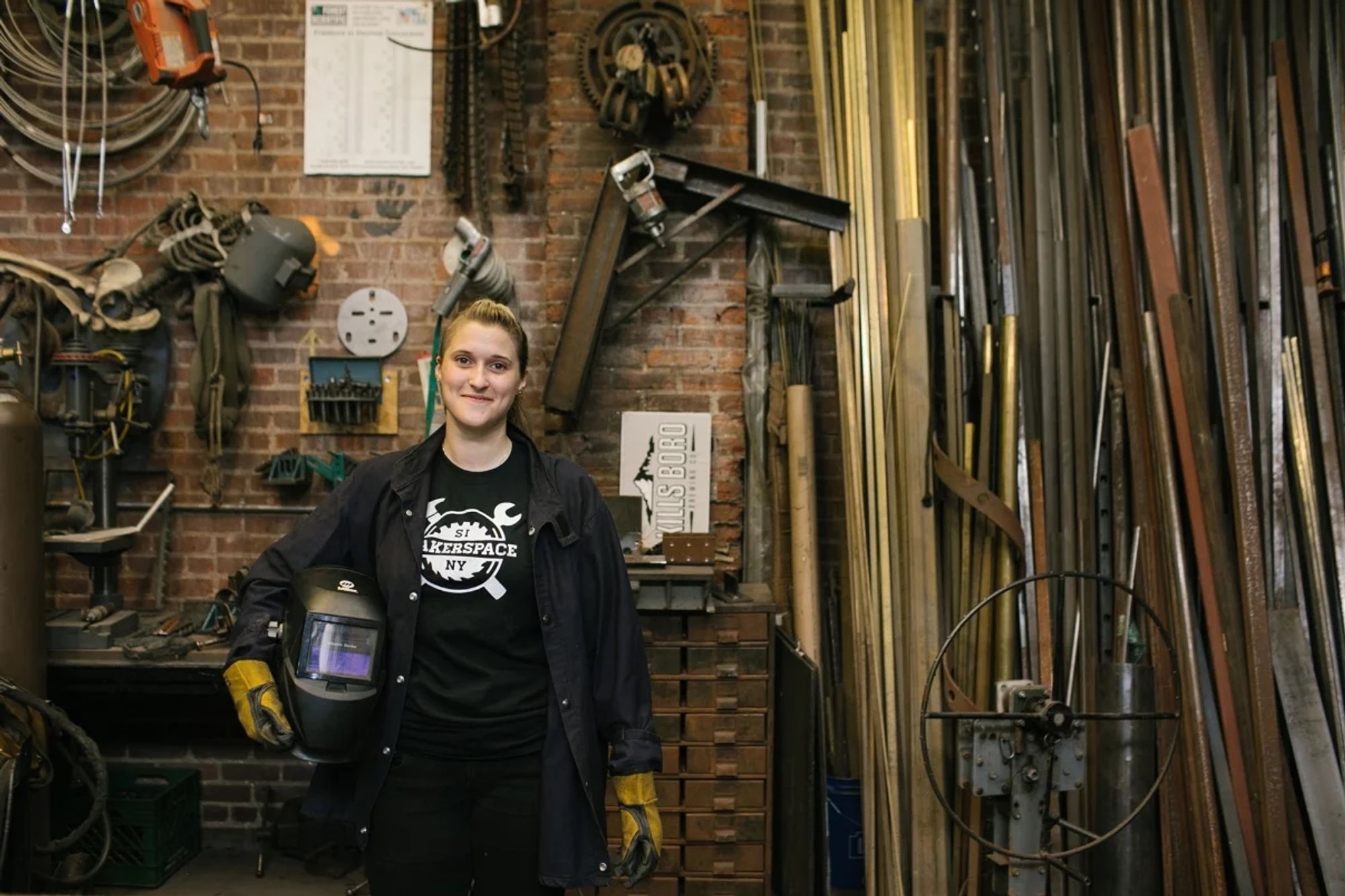
Photo taken from the New York City Economic Development Corporation's website.
New York City’s Industrial Business Service Provider (IBSP) program lends a guiding hand to the city’s robust community of manufacturing enterprises in the form of business education, financing assistance, recruitment, and training support. But despite its essential role, IBSP is at risk of being dismantled as the Mamdani administration looks for solutions to reduce a long-term budget deficit.
On Monday, March 23, 2026, Mechanism’s Co-Executive Director Nepal Asatthawasi gave testimony during the City Council Small Business Committee Hearing explaining why the IBSP matters. She explained that now is not the time to signal disinvestment in the industrial sector, whose careers provide a lifeline to a great diversity of New Yorkers and offer employment stability while AI threatens the knowledge economy the city has invested so heavily in.
Read her full testimony below:
Attention: City Council Small Business Committee Hearing, March 23 2026
We have watched with hope as the Mamdani administration has taken the question of who NYC’s economy is actually working for seriously. We write now because the proposed elimination of the Industrial Business Service Provider (IBSP) program would move that project in exactly the wrong direction. Eliminating IBSPs would be a mistake that would deepen NYC’s inequality, undermine its economic resilience, and abandon the workers and small businesses that need the City's support most. We urge the administration and SBS to reverse this decision.
For our first decade, we operated as the Urban Manufacturing Alliance, founded in NYC, where we helped launch the Made in NYC initiative and built the national case for urban manufacturing as a core economic development strategy. Now as Mechanism, we partner with communities, municipalities, and economic development agencies to plan and develop production ecosystems that increase local resilience and well-being. We work to fix the systems that have allowed manufacturing to erode, and with it, the economic security and stability of working-class communities. NYC is where this work began. What happens here still matters to us, and matters nationally too.
NYC is one of the most unequal cities in the world, and that did not happen by accident. It is the direct outcome of decades of shortsighted policy choices that prioritized the knowledge economy, finance, and tech industries while allowing the industrial sector to erode. The businesses and jobs that have sustained immigrants, New Yorkers of color, and workers without college degrees - the very people systematically excluded from the high-wage economy - have been allowed to shrink, squeezed by rising rents, speculative real estate, and the absence of dedicated policy. The IBSP program is one of the few remaining mechanisms the City has left to counteract this trajectory. Eliminating it tells the immigrant business owner in Maspeth, the garment worker in Sunset Park, and the food manufacturer in the South Bronx that the city has decided their economy is not worth saving or even having.
The numbers demonstrate the stakes:
- The industrial sector provides over 500,000 jobs (nearly 15% of the city's workforce) and generates over $1.7 billion annually in tax revenue.
- 32% of NYC jobs that pay over $50,000 and don’t require a college degree are industrial jobs, more than any other sector.
- Industrial businesses offer real mobility to a workforce that is 67% people of color and 70% of whom do not possess a degree.
These jobs are the primary remaining pathway to the middle class for New Yorkers most often left behind. Without doubt, they depend on the specialized support that only IBSPs provide.
We are entering an era of what many recognize as a polycrisis: accelerating climate shocks, geopolitical instability, fractured global supply chains, and economic volatility that no single policy can predict or prevent. When global supply chains collapsed during the pandemic, the city's remaining industrial sector - composed of its garment workers, food manufacturers, medical supply producers - became an emergency resource. As NYC pursues a Green New Deal transition, it will depend on its industrial sector to design, manufacture, install, and maintain green technologies. IBZs contain freight logistics, cold storage, waste processing, electricity distribution, energy storage, advanced manufacturing capacity, and other capabilities that the city cannot afford to lose. The businesses that can flex to meet changing needs are small manufacturers, who also are the most agile, community-rooted producers in the ecosystem. IBSPs keep them viable and connected.
There is one more disruption that demands attention: AI is already transforming the knowledge economy that New York has spent decades building. No one knows exactly how this will unfold, but manufacturing jobs — that require physical skill, spatial judgment, and craft — have proven far more resistant to automation than the office economy New York has bet everything on. Protecting and growing the industrial sector now is a hedge against the workforce displacement that is coming. A city that preserves its manufacturing base will be far better positioned to absorb shock than one that lets it disappear.
We understand the city is facing a serious budget deficit. We do not dismiss this difficult reality. But the IBSP program costs just $1.2 million citywide, a figure so modest it amounts to a rounding error in municipal finance. For that investment, the city sustains the backbone organizations that keep hundreds of industrial businesses alive, growing, and employing marginalized New Yorkers. These are businesses that generate tax revenue, anchor neighborhoods, and provide the kind of stable employment that reduces long-term demand on city social services.
The proposed alternative of a single rotating generalist staffer per borough through the Business Solutions Center is an insufficient substitute for what currently exists. Industrial firms require specialized support from organizations embedded in their sector and communities. That is what IBSPs provide, built over decades of institutional knowledge and relationships based on trust and it cannot be replicated by drop-in services.
We ask the City to take three steps:
- Remove industrial businesses from the Business Solutions Center RFP;
- Extend existing IBSP contracts by at least one year to ensure continuity; and
- Work with the industrial community to co-design a modernized program that addresses rising real estate pressures, connects manufacturers to green economy opportunities, strengthens workforce pipelines, and reinvests in the Industrial Developer Fund.
A more equitable NYC is not possible without a strong industrial sector. The IBSP program is one of the most important tools the city has for building the economy this administration claims it wants. We urge you to protect it.
Sincerely,
Nepal Asatthawasi
Co-Executive Director
Mechanism